The Long Riders' Guild
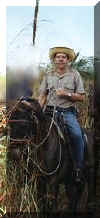
Georges Baudraz, Sylviane Gold and Rodolfo
Bravo's
historic ride across Cuba!
|
|
Georges Baudraz, Sylviane Gold and Rodolfo Bravo are making preparations for a unique ride across Cuba! |
Three
horsemen, one Cuban and two Swiss, Rodolfo Bravo, Sylviane Gold and Georges
Baudraz are proposing to follow the historic trail of the armed battle of the
Cuban people for their independence. With
a good deal of experience in horseback travel plus his interest in Cuba’s
history, Georges Baudraz will follow the trail of Antonio Maceo during the War
of Independence of 1895.
Antonio
Maceo is a figure who marks Cuba’s history of independence.
His epic began on 1 April 1895 when, accompanied by 22
patriots, Maceo arrived at the Cuban coast, near Baracoa in eastern Cuba, on
the schooner ‘Honor’. This
expedition, which was called ‘the Third War of Independence’, led him as
far as the westerly point of the island and ended for Antonio Maceo in a
battle with the Spanish army at San Pedro, near Havana.
It was during this fight, on 7 December 1896, that he
lost his life at the age of 51. This
campaign remains a celebrated event in Cuba’s independence.
Antonio Maceo was erudite, a writer, poet, philosopher, a friend of José
Marti and Maximo Gomez, and was also a military strategist who climbed to the
rank of major-general.
Marti
said of him that he had “arms as strong as his head.”
The people of Cuba regard him as a hero.
He was a half-caste, nicknamed ‘el Titan de bronce’, he devoted
thirty years of his life to the liberation of his country.
Itinerary
The
equestrian expedition, ‘Maceo 2002’, will leave Baracoa, in eastern Cuba,
and head for Manhua in the west of the island, trying to follow as faithfully
as possible the trail, the places, and the historical locations of Maceo’s
campaign of 1895.
This
trail goes along the centre of the island without ever touching the coasts.
The length of the journey is estimated to be about 1400 km (875
miles), and will be done on horseback, if possible with the same three horses,
in order to demonstrate the strength of the Cuban horse.
The daily stages should allow them to cover at least 20 to 30 km per
day (12 to 20 miles). Taking into
account the unforeseen problems, days off and cultural meetings which are
inherent in the project, the expedition should take between 60 and 75 days.
Participants
Georges
Baudraz has been a specialist teacher and sociotherapist with the Department
of Health in Geneva. In 1989 he
set up an agency for equestrian travel, ‘Le Cheval Vert’ (The Green
Horse), and organised and led more than twenty horseback expeditions,
including seven in Cuba.