Helpful Hints
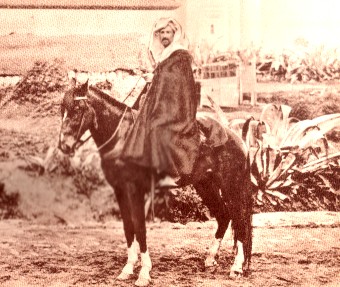
Famed Scottish Long Rider, Don Roberto Cunninghame Graham, is seen riding in disguise across North Africa in the late 19th Century. Click on photo to enlarge.
|
|
Helpful Hints Famed Scottish Long Rider, Don Roberto Cunninghame Graham, is seen riding in disguise across North Africa in the late 19th Century. Click on photo to enlarge. |
Long Rider Comments
| My experience has been,
don't bring it, don't bring it, don't bring it. The safety-mongers
would have you bring farrier service and a vet-mobile with you, as well as
pounds worth of camping, safety, and first aid gear. On both of my
trips (one in 1993 and one in 2001) I brought no pack animal, so I had to
pack extremely lightly on my saddle horse. It is incredibly
important to lighten the horse's load, and I will make a few points about
things I discovered I didn't need, as well as listing essential gear.
People will encourage you to bring lots of other stuff. They will give stuff to you as bon-voyage presents. These are people accustomed to stuffing their vehicles with Coleman stoves, hammocks, insulite pads, folding chairs, and other non-essential camping supplies. Even people who go horse camping, but only go for a few days or weeks at a time, do not know what it is like to live on the trail. Not only do you not want the weight on your horse, you don't want the hassle of loading and unloading it, or of digging through it to find something. I admit I did take one packet of glove-warmers with me, and I saved them to put them in the foot of my sleeping bag on a really cold night and was glad to have them. It was a nice treat. But be as firm as you can and say no to as much clutter as possible.
A horse should carry more than 1/5 of his or
her weight, so adjust accordingly, and bring a pack horse if necessary.
Never load a pack horse with more than 100 pounds, because you ride
better than dead packs do, and 100 pounds of dead weight is more than
200 pounds of your weight. Since I was right on the edge of what
my horses should carry, I walked much of the time. First thing in
the morning, Shawnee wanted me on her back so she could zoom, but as the
day wore on she was happy to have me walk, and would even nicker to me
in gentle request that I do so.
Lisa Wood |
||
Leatherwork - I soaked everything overnight in a tub of good old-fashioned neatsfoot oil before departure. With an occasional lick of saddle-soap, it all remained soft and in good order, even in the wettest conditions. Personally, I think neatsfoot oil is much better than any of the new-fangled leather dressings! Mary Pagnamenta |
||
|
Water. Dehydration is a problem, yes even on day
rides with tourists in the mountains here in Romania. One needs to carry
enough water and to drink it. In general one needs to watch one's
health.
Riding. It tends to be slow. Mostly at the walk.
Keep the distances within reason. Give the horse rest days.
Companions. It's best to go with someone with
similar aspirations if one can stand it. But relationships can and will
go wrong under strain. One needs to be a strong character. And to be
interested in the place that one is visiting. Keep a diary - it gets a
lot off one's chest.
Maps. Fine if one has good ones. But common sense
and a feeling for terrain are important. I've never found the need for a
GPS, but probably there are places where one will be useful.
Julian Ross |
| Of course there were no GPS's
or mobile phones then, and the only instruments I had were an altimeter to
7 kms and a compass (which didn't like magnetite in them thar
hills!) Most important kit: Petzl headlamp, two large
polythene bags, Swiss Army knife, canvas 'bucket-bags' ex army surplus,
cheapest form of lighter.
John Labouchere |
| Some horses have a sixth sense
and you would do well to pay attention!
This summer I was nearly attacked by a wood-cutter, but my mare, who normally grazes quietly while I am talking to somebody, became very agitated and could doubtless sense his bad intentions. We shot off at a gallop, even though the wood-cutter had her by the reins and she KNEW that the hackamore would bang her on the nose, but she did not hesitate to flee. And I am convinced that she did this not for her sake but for mine, as she sensed that I was in danger. Evelyn Coquet, in her book about her travels in Scotland with her husband, writes about one of her horses who refused to budge. When Evelyn insisted, they fell into a bog out of which they had the greatest difficulty in extricating themselves. I feel that when a close relationship has built up between rider and horse(s), it is easy to tell the difference between a horse that is playing up and one who senses danger ahead. I have also noticed that many times, when deciding which route to take in the mountains, my mare always knows the best way to go and I should listen to her. If I make the decision myself, I have frequently found myself in a dead-end situation, whereas the route my mare wanted to take originally is always the right one! You should also teach your horse to obey voice commands - it is very useful in tricky places if you can command your horse to go left, turn right, stay in the middle, turn around, etc. Isabelle Saupiquet |
| We discovered a couple of
things that Long Riders might find useful. First of all, commercial
leather hobbles don't work well long term. They can sore the horse. What
we found works really well is to take a 3/4 or 1 inch cotton rope, unbraid
it, and then rebraid it in a three-strand braid to make an excellent, soft
pair of hobbles. This works in country that does NOT have burrs or sticky
seeds, which will catch up in the hobbles and cause chafing. A good picket pin can be made with a piece of angle iron with a hold drilled in top, with a loose, welded ring through it on which goes a heavy bullsnap. I have yet to find a commercial picket pin worth a damn. Nothing, nothing is more important in packing a horse than in balancing the load. Not only should the panniers be of exactly equal weight, but the distribution of weight in each pannier should be symmetrical to each other. As for training a horse to pack well, we discovered some useful tricks. Take a space blanket and work with the horse in a large open area (not in a confined corral and god forbid not snubbed!) on a long soft rope. Preferably on a windy day. Throw the space shiny blanket over the horse's back and neck again and again, letting him get used to it. He'll be very frightened at first, of course, but a very gentle, calm and kind approach will help him learn that the shiny, rattling piece of plastic is harmless. This really helps when a horse is packed with some loose things that might flap or rattle if the horse starts to run. It's also a great help if you're using a plastic tarp as a manty and the wind is blowing, rattling the tarp. A horse trained in this way with a space blanket just won't spook. As for training a horse to be staked out on a long rope -- this is essential for any horse being taken where there are no corrals or where the horse has to be tied up to bushes, rocks, or trees. I start with a 30 to 40 foot heavy cotton rope on the horse's halter, tying the other end to a heavy tire that the horse can move only slightly but NOT DRAG. Then I put the horse in a BIG field (no barbed wire anywhere near) and let him work it out. He'll get tangled up but because the heavy tire moves slightly he'll be able to free himself -- usually. (Keep an eye on him, of course, but let him do most of the work.) Eventually, he'll be so clever with long ropes that you can tie him high, low, on a fifty foot rope with brush all around -- and he'll never have a tangle. I had a horse who knew ropes so well that if he got a rope wound around a leg, he's lift up the leg and give it a little shake, dropping the loops right off. It's so important for a horse being taken on a long ride to know all about ropes. I also train my horses to be mounted from the left or right. I've never understood why horses have to be mounted from only from one side. I've been in some tight spots where I had to mount or dismount on the right, and I want my horse to be used to it. I found a cowbell to be an absolutely essential item of travel. At night, I'd bell the lead horse and then the hobbled horses could graze far and wide, and I could find them in the morning. A second useful trick, if the grass is good, is to stake one horse and hobble the others, expecting that the herd attachment will keep them all together. To train a horse to "ground tie," which is essential if you pack horses in open desert country where there are no places to tie them up, you can take the lead rope, run it through a ring in the ground (the picket pin I suggested above works well) and then tie it to a hobble on one front foot. When the horse moves his head he feels his foot tugged, and when he moves his foot he feels his halter tugged, and as a result he learns that the best thing to do is not move at all. In this way, if you're packing a horse and don't want him to move, you simply drop the lead rope and the horse will stand stock still while you work. He doesn't need to be tied. I also feel it's important not to coddle horses or assume they are fragile and delicate and are going to get into trouble. It's a question of trust. If you trust a horse, if you teach him responsibility and if you assume he's going to do the right thing in a tricky situation, he learns to trust himself and his own judgment. Horses that are over managed, over coddled, who are never given a chance to use their own judgment and sense, are dangerous to take on a long ride. I call them country club horses. I like to find an area for my horses to run around in that has a lot of rocks, steep difficult terrain, even cliffs or dangerous holes. The horse learns where to put his feet, he learns to trust himself, he learns that not everywhere he goes is there going to be a nicely groomed riding trail. He learns to take responsibility for himself and his own safety. I've found that horses raised in this way are much less likely to injure themselves than a horse kept in a stall and turned out in a nice groomed ring or gentle pasture. Here I was going to talk about equipment but instead I've talked about horses. Long riding begins and ends with horses. Nothing is more important than a good horse and a rider who understands him and takes care of him. All the best equipment in the world, the super light saddles and such, won't help if you don't know your horse and if you don't always -- always -- put your horse and his needs first. I've always used old-fashioned cowboy equipment and saddles, not because I think they're better (they're not) but because that's what I'm used to and know how to fix. There is a lot of great new equipment out there, beautifully designed saddles and tack, but nothing can substitute for having a deep knowledge, sympathy, and feeling for horses. Doug Preston |
| Saddles, saddle-pads & saddle-bags | Pack saddles | Horse-shoes & hoof care | ||
| Horse training | Tents | Solar power & laptops | Clothing | Camping equipment |
|
Click
here
to see the world's largest collection |
|