To contact Hill Country Horseshoeing School: http://www.Hillcountryhorseshoeingschool.com
Howard Saether and Janja Kovačič
Horse shoes and hoof care - page 3
|
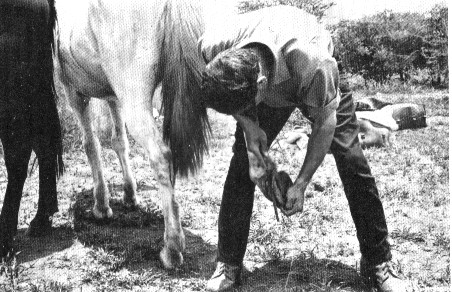
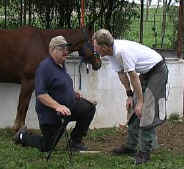
I (Howard) am very glad
that I spent the money and time going to Hill Country Horseshoeing School
in Texas before starting our trip. I can't imagine how we would have
come so far, without what I learned there. What we have seen of
horse shoeing so far, with a few exceptions, were usually terrifying.
Thank you Mike Chambers! To contact Hill Country Horseshoeing School: http://www.Hillcountryhorseshoeingschool.com Howard Saether and Janja Kovačič |
| Local nails go with local
shoes. Western nails don't fit peasant shoes. Most of the
shoeing in Romania is lousy. But the local shoes tend to last,
whatever some people say about calkins and toe pieces not being right.
Julian Ross |
|
I carried an Easy Boot on the first trip but
never used it. It's a heavy, bulky item, unnecessary because for my
travels in the U.S. I found farriers surprisingly easy to come by.
It only took a few days to get through wilderness areas, and I made sure
the shoes were in good order before moving into such areas. For those of
you traveling in more remote countries, you may need to pack your own
farrier supplies.
Traveling every day you will find there is nothing to pick out of your horse's hooves. Only once in 4,500 miles did a stone lodge in one of my horse's hooves, and I used a knife to pry it out. I carried a hoof pick on my first long ride (up the coast of California), but because I never used it, I didn't bother taking one on my journey with Shawnee (across the US). Depending on the mileage and terrain, the hooves may start to look like Swiss cheese from the holes produced by frequent shoeing (make sure farriers only use three nails instead of four, to minimize the Swiss cheese effect). With high mileage and rocky terrain, heavy duty shoes can wear out in as little as two weeks. If this happens, search for a farrier who can put borium shoes on for you - they wear like diamonds. Don't do it unless you must, though, because the chunky borium will inhibit the natural slide a horse makes as his hoof hits the ground, causing excessive jarring, which is not good for the joints. I never put any borium on Cacho on his 1,500 mile trip, but Shawnee got two sets with borium on our 3,000 mile trip.
Hoof moisturizer may be necessary if you are
crossing a desert. A rancher gave me a tube in New Mexico and I
used it regularly on Shawnee until I got far enough east that the ground
was not so incredibly dry. If you will be crossing a dessert it
would be appropriate to bring a thick, all purpose moisturizer such as
petroleum jelly - you can safely use that almost anywhere on the horse,
and on your own lips and hands.
Lisa Wood |
|
Mongolian horses are not shod!
Evelyn Landerer |
|
Undoubtedly
the worst "equipment" we had to deal with were the horse shoes
we had to buy in Ecuador. The steel was so soft they would be worn down
in 2 weeks, partly due to the cobbled stone roads frequently found
around small towns. I have no idea how to get round that one as horse
shoes are just too heavy to take with you. By the end of the ride our
poor horses hooves were riddled with nail holes and we had to rest up to
allow for hoof growth.
Wendy Hofstee |
|
An Important Alternative View ! Late in 1970 I departed on a 20,000 kilometer horse trip that was to take me from Lesotho, Africa to Austria and take nearly two years. A great problem was that of horseshoes. Going North from southern Africa there is a long ride before reaching Kenya, where shoes are available. Carry enough shoes? Ouch! Much discussion arose, with the vast majority saying that the shoes were needed. Then I thought of all the wild horses and wondered how they got on without a Smithy to visit. Made up my mind to forego the shoes, with the riding fraternity calling me mad, stupid, and worse. But, no shoes for the horses! The decision taken, I went and bought horses in Lesotho where the vast majority are unshod. I looked for horses with black hooves (ed. note - because of their legendary hardness). Eventually took one with a white hoof but it was soon relegated to carrying a light pack. The drill was to start the trip slowly and give the hooves time to get to their hardest. At the end of each day a mark was made on the hoof with a file, one inch up from the front of the hoof. To start with the marks were in the wrong direction as the hoof wore faster than it grew. In two months the hoof was strong enough for us to ride for eight hours on a daily basis. At one point in the north of Rhodesia (now Zimbabwe) we used strap-on shoes to protect the hooves where the ridge tops were broken volcanic rock. These (emergency) shoes would have been better if they were made with cloth ties instead of straps. But they did the job for the one day they were required. It
may be of interest that after
arriving in
Germany, the horses were retired to a farm. The new owner insisted they should be shod and called in the smith.
The blacksmith was unable to make any marks on the hooves with his rasp.
In fact the horses were not shod for more than a year, until such time as the hoof
had grown softer. After that, to keep the horse's hooves in shape the
farrier used a grinder on the hard hooves. For the new owner could not
afford the time to ride the horses enough to keep the hooves worn down. Gordon Naysmith
|
| Page 1 | Page 2 | Page 3 | Page 4 | Top | Home |
| Saddles, saddle-pads & saddle-bags | Pack saddles | Horse-shoes & hoof care | ||
| Horse training | Tents | Solar power & laptops | Clothing | Camping equipment |